
Srinagar, October 7, 2025 –
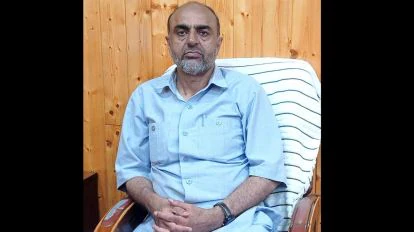
In a swift administrative move, Bashir Ahmad Shah, the in-charge Chief Education Officer (CEO) of Baramulla district, was removed from his position and attached to the Directorate of School Education Kashmir (DSEK) on October 6, pending an inquiry into a controversial circular he issued over the weekend. The order, issued by the administrative secretary of the School Education Department, comes amid growing scrutiny over efforts to regulate government employees’ online activities, raising questions about free expression in an already tense region.
The action against Shah stemmed directly from a circular he released on October 4, directing all teaching and non-teaching staff under the School Education Department in Baramulla to avoid criticizing government policies on social media platforms. The document, circulated after a departmental meeting on October 3 chaired by the administrative secretary, emphasized strict adherence to existing guidelines and warned against posting “inappropriate content” or engaging in “unwarranted debates and discussions.” It explicitly labeled such activities as a violation of a 2023 government circular on social media conduct, which prohibits employees from interfering in policy matters through online channels.
The circular highlighted instances of “misuse” of social media by staff, as discussed in the Friday meeting, and instructed CEOs across districts to report violations for accountability. Consequences outlined for non-compliance were severe, including censure, fines, withholding of increments or promotions, demotion, pay recovery, premature retirement, or outright removal from service. Notably, it clarified that staff were not prohibited from using social media for “positive and constructive purposes,” such as sharing educational resources or community updates.
The administrative secretary’s attachment order stated: “Pending inquiry, Bashir Ahmad Shah, in charge CEO Baramulla, is hereby attached with the Directorate of School Education Kashmir with immediate effect.” In his place, the CEO of neighboring Bandipora district has been assigned additional charge of Baramulla until a permanent replacement is named. This reshuffle aims to ensure continuity in the district’s education operations, which serve over 1,200 schools and more than 2.5 lakh students in Baramulla alone.
The circular quickly drew public ire, amplifying concerns over curbs on dissent in Jammu and Kashmir. On October 5, prominent People’s Democratic Party (PDP) leader Waheed Para took to X (formerly Twitter) to denounce it, posting: “In an already numb Jammu and Kashmir, this order by the J-K govt’s education dept warning teachers and govt staff against raising their voices is deeply concerning. A govt that came to power on the promise of giving people a voice is now contributing to silencing the few remaining ones in Jammu and Kashmir.” Para attached a scanned copy of the circular, which has since garnered over 5,000 views and sparked debates among educators, activists, and opposition figures.
This incident unfolds against a broader backdrop of the Jammu and Kashmir government’s evolving stance on digital expression. In 2020, the administration rolled out a New Media Policy aimed at monitoring and regulating online content, which faced backlash from journalists and civil society groups for its perceived “authoritarian undertones,” including provisions for penalizing “fake news” and anti-national posts. More recently, in late 2024, the government informed the Legislative Assembly that it was drafting an updated media policy to address emerging challenges on digital platforms like X, Instagram, and Facebook. Critics, including human rights advocates, argue these measures disproportionately target public servants in sensitive sectors like education, potentially stifling constructive feedback on issues such as school infrastructure deficits or teacher shortages in remote areas.
Education officials in Baramulla, speaking anonymously on October 6, described the circular as an attempt to maintain “professional decorum” amid rising instances of staff using personal accounts to comment on policy rollouts, including recent reforms under the National Education Policy 2020. One teacher from a government higher secondary school in Sopore noted: “We understand the need for restraint, but equating policy questions to ‘interference’ feels heavy-handed, especially when schools in flood-hit areas are still without basic supplies.” Baramulla, with its mix of urban centers and rural pockets along the Line of Control, has seen heightened online discussions on education challenges post the August floods, which damaged over 150 schools in north Kashmir.
The inquiry into Shah’s circular is expected to wrap up within two weeks, with DSEK tasked to oversee the process. Meanwhile, the School Education Department has reiterated its commitment to fostering a “balanced” use of social media, urging employees to channel concerns through official grievance portals rather than public forums. As the probe unfolds, it adds to a string of recent administrative overhauls in J&K’s education sector, including the transfer of 15 zonal education officers in September 2025 amid allegations of irregularities in mid-day meal distributions.
For Baramulla’s educators and families, the episode underscores ongoing tensions between administrative control and open dialogue. With winter approaching and assembly polls on the horizon, such moves could fuel further political discourse on governance transparency.