
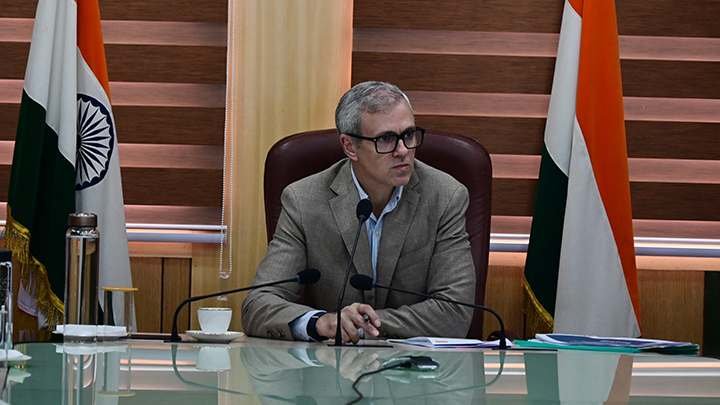
JAMMU: Underscoring that transparency and meritocracy represent non-negotiable pillars of youth empowerment, Chief Minister Omar Abdullah called for comprehensive and institutionalized reforms across the examination and public recruitment architecture of Jammu and Kashmir, directing that testing systems be made foolproof, transparent, and technology-driven to insulate student careers from administrative vulnerabilities.
Chairing an exhaustive review meeting with members of the national High-Powered Task Force (HPTF) on Examination Reforms at the Civil Secretariat in Jammu, the Chief Minister pledged total administrative backing to implement modern testing protocols. The discussions focused on reinforcing question paper logistics, phasing in Computer-Based Testing (CBT), harmonizing school board scores, and removing discretionary subjectivity in oral interviews.
Abdullah observed that the nationwide turmoil and anxiety stemming from the abrupt cancellation and re-examination of NEET-UG underscored the critical urgency of overhauling national and regional assessment frameworks to restore student confidence.
Advocating a structured, phased transition toward digital computer-based assessments, the Chief Minister cautioned that candidates from rural and border regions must be adequately equipped and familiarized with digital exam interfaces before widespread compulsory deployment. To reduce disproportionate student stress associated with single-day high-stakes entrance exams, Abdullah suggested evaluating models that factor in cumulative school board performance, emphasizing the creation of scientific normalization matrices across disparate boards—including JKBOSE, CBSE, and ICSE—to ensure absolute fairness.
Addressing persistent candidate grievances regarding viva-voce and interview evaluations, the Chief Minister instructed the Task Force to devise objective rubrics and digital scoring mechanisms to eliminate perception of bias or manual score tampering.
Commissioner Secretary Higher Education Ram Niwas Sharma outlined existing institutional safeguards, including police-escorted logistics, biometric frisking, CCTV surveillance of strong rooms, and digitized result publishing across JKPSC and JKSSB examinations.
The high-profile meeting was attended by Health Minister Sakina Itoo, Education Minister Shamim Firdous, Acting Chief Secretary Shailendra Kumar, ACS Dheeraj Gupta, Chairman JKSSB, alongside eminent Task Force members including Director Intelligence Bureau Tapan Kumar Deka and IIT Madras Director Prof. V. Kamakoti.
Published by True Roots Media