
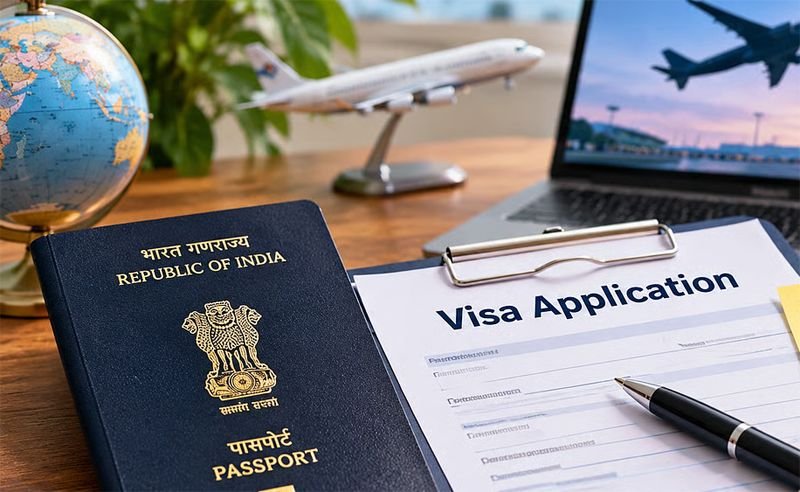
NEW DELHI: In a decisive move to dismantle bureaucratic bottlenecks and boost inbound tourism, business travel, and academic mobility, the Ministry of Home Affairs (MHA) has overhauled the national visa regime, reducing the number of main visa categories from 13 to nine and sub-categories from 49 to 23, while slashing application form fields by 65 to 70 percent.
The landmark reform follows an in-depth comparative study of visa systems in developed economies, designed to make India’s entry permits compact, transparent, and aligned with international best practices. The revised structure will take complete operational effect by the end of 2026 as backend immigration software updates conclude.
Under the restructuring, the erstwhile Tourist Visa has been renamed the Visitor Visa, recognizing travel that transcends conventional sightseeing. It has been condensed into two distinct streams: V-1 (a 30-day multiple-entry permit covering short business meetings, wellness retreats, medical consultations, and language or craft workshops) and V-2 (offering long-term multiple-entry validity spanning 1, 5, or 10 years, as well as dedicated 6-month multiple-entry permissions for mountaineering expeditions).
In a significant boost for medical value travel, the Medical Visa framework now offers dedicated 1-year default multiple-entry permissions for conventional treatments (M-1) and traditional AYUSH medicine (M-3), alongside corresponding attendant categories (M-2 and M-4) to eliminate repetitive applications during extended treatment or staged follow-ups.
The Student Visa category has been bifurcated into S-1 (encompassing school, undergraduate, and postgraduate degree courses with multiple-entry validity up to 5 years via the Study in India portal) and S-2 (dedicated to doctoral researchers, visiting fellows, anthropological and scientific expeditions, and academic exchange programmes).
Business mobility has been consolidated into B-1 (long-term, license-based commercial enterprises) and B-2 (short-term, contract-driven operations, creative arts, and conferences). Crucially, a specialized fast-track e-visa route under B-2 has been established for foreign engineers, supply-chain architects, and technical specialists deputed for plant commissioning, high-tech installations, and technology transfers.
The consolidated nine core categories comprise Business, Diplomatic, Work, Journalist, Medical, Official, Student, Visitor, and Miscellaneous visas. Officials noted that curtailing application form complexity by up to 70 percent will dramatically reduce filing times for foreign applicants while allowing immigration authorities to conduct focused, efficient security verifications.
Published by True Roots Media