
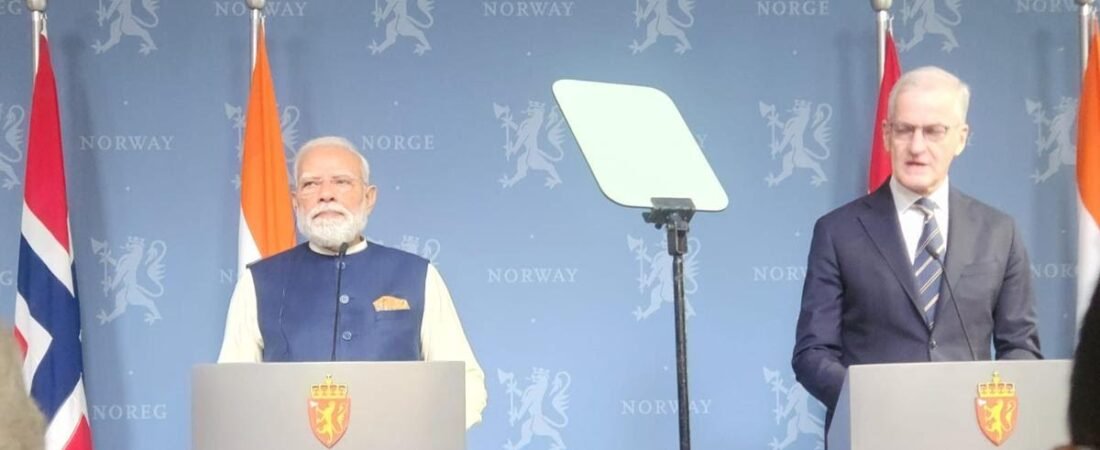
Trade and energy cooperation are expected to dominate discussions as Prime Minister Narendra Modi arrived in Oslo on Monday (May 18, 2026) for the first-ever bilateral visit by an Indian Prime Minister to Norway, a leading global exporter of oil and natural gas.
During his two-day visit, the Prime Minister will meet King Harald V and Queen Sonja and hold bilateral talks with Prime Minister Jonas Gahr Støre. According to a statement from the Ministry of External Affairs (MEA), the discussions will focus on reviewing progress in India-Norway ties and exploring ways to further strengthen cooperation, particularly in trade and investment.
The visit will also feature the 3rd Nordic-India Summit on Tuesday, May 19, 2026, bringing together the leaders of Norway, Sweden, Finland, Iceland, and Denmark. The summit was postponed last year following the Pahalgam terror attack and the subsequent four-day India-Pakistan conflict. Regional and global issues, including the conflicts in Ukraine, Iran, and Gaza, are also expected to figure prominently in both bilateral and multilateral discussions.
On Sunday, May 17, 2026, India and Sweden agreed to upgrade their ties to a Strategic Partnership during talks between Prime Minister Narendra Modi and Swedish Prime Minister Ulf Kristersson. The discussions focused on strengthening cooperation in trade, technology, defence, and several other important sectors.
Mr. Modi, who arrived earlier in the day for a two-day visit, was also conferred with the ‘Royal Order of the Polar Star, Degree Commander Grand Cross’ in recognition of his outstanding contribution to India-Sweden relations and his visionary leadership.
Prime Minister Narendra Modi, speaking in Norway, said India and Europe are entering a “golden era” of trade driven by the proposed Free Trade Agreement (FTA). He announced that India and Norway are elevating their ties to a Green Strategic Partnership, highlighting cooperation in sustainable development and maritime initiatives.
Mr. Modi said Norway’s participation in the Indo-Pacific initiative would strengthen collaboration in marine economies, maritime security, and capacity building. He added that both nations believe dialogue and diplomacy are the only ways to resolve conflicts, including those in Ukraine and West Asia.
Addressing global challenges, the Prime Minister stressed the need to reform international institutions. He also reiterated that eliminating terrorism remains a shared global objective and emphasized that military conflict cannot provide lasting solutions to international issues.
Prime Minister Narendra Modi thanked Norway for standing with India against terrorism, stating that conflicts in Ukraine and West Asia are contributing to global instability. He said India and Europe are entering a “golden age” of relations amid growing geopolitical uncertainty.
Speaking alongside Norwegian Prime Minister Jonas Gahr Støre, Modi said India and Norway are exploring deeper cooperation in areas such as healthcare, space, digital public infrastructure, and green development. He added that while both democracies may have differences, they must work together to counter the weaponisation of trade, resources, and free passage, as well as rising unilateralism and protectionism.
Earlier in the day, India and Norway elevated their relationship to a Green Strategic Partnership following bilateral talks between the two leaders in Norway.
The discussions focused on expanding cooperation in trade and investment, green technology, the blue economy, and other key sectors. Modi, who arrived in Norway on a two-day visit from Sweden, was received at the airport by Prime Minister Støre and senior Norwegian officials.
This marks Modi’s first visit to Norway and the first visit by an Indian Prime Minister to the Scandinavian nation in 43 years.
Prime Minister Narendra Modi is set to address the India-Norway Business and Research Summit alongside his Norwegian counterpart, the MEA announced.
PM Modi was accorded a grand reception by the Indian diaspora in Norway, featuring colourful cultural performances.
Norway has developed a comprehensive maritime cluster that spans the entire value chain, including ship design, equipment manufacturing, shipyards, shipping companies, financial services, insurance institutions, and shipbrokers. Representing Norway at an event of this scale that brings together every part of the maritime sector is both an honour and an opportunity filled with possibilities.
For both Norway and India, the ocean is a natural asset that connects our economies and our people, forming the foundation of a strong bilateral partnership. India plays an important role in global shipping as a hub for trade, shipbuilding, and ship recycling, and it also contributes strong technological and digital capabilities to the maritime sector.