
Preserving Dogra culture is not about resisting modernity. It is about ensuring that our traditions have a place in the future.
By Ashok Sharma | True Roots Media | 11 November 2026
There was a time when music was not something we searched for on a mobile phone. It was part of everyday life. Weddings, family celebrations, agricultural activities, and religious gatherings brought people together through songs that had travelled across generations.
In the villages of Jammu Division, many of these songs were never written down. They survived because someone remembered the words, someone knew the melody, and someone was willing to teach the next generation.
Today, our children have access to music from almost every corner of the world. That is a wonderful opportunity. But it also raises an important question: are we making enough effort to introduce them to the music of their own communities?
The Cultural Wealth Hidden in Our Homes
Dogra folk traditions include wedding songs, seasonal celebrations, devotional compositions, and storytelling through music. Among them are suhag songs associated with marriage ceremonies and bhakh, a traditional vocal expression recognised within the region’s musical heritage.
These traditions are more than entertainment. They preserve memories of family relationships, community values, changing seasons, and the experiences of ordinary people.
Some of our most important cultural custodians are elderly women who learned these songs from their mothers and grandmothers.
Their knowledge deserves recognition alongside the contributions of established artists.
Yet cultural preservation should not mean treating traditions as museum exhibits. Music survives when people continue performing, adapting, and sharing it.
Technology Can Become a Bridge Between Generations
Across the world, regional musicians are using digital platforms to introduce traditional sounds to younger audiences. Jammu’s artists can do the same.
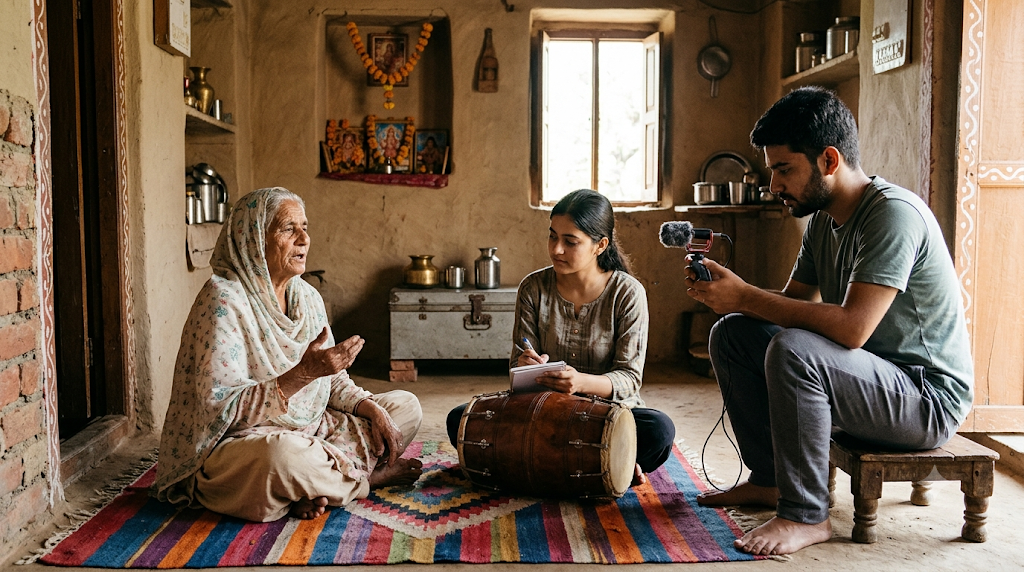
Imagine a young musician recording a traditional Dogri song with an elderly village singer, documenting its meaning, and creating a contemporary arrangement while acknowledging its origins.
Schools could invite local performers to explain traditional musical forms. Colleges could organise workshops where students learn the stories behind songs rather than simply memorising performances.
Digital archives could preserve recordings, lyrics, and interviews with artists, subject to their consent and appropriate cultural permissions.
Such initiatives would also create opportunities for young musicians, sound engineers, filmmakers, researchers, and digital creators.
Let Our Identity Travel With Us
Preserving Dogra music does not require rejecting Hindi, Punjabi, English, or international music. Cultural confidence grows when people can appreciate different traditions without feeling embarrassed about their own.
Jammu Division itself is home to several languages and cultural communities. Celebrating Dogri should strengthen respect for this diversity rather than diminish it.
Our young people deserve the freedom to explore the world while remaining connected to their roots.
Perhaps the most meaningful beginning is also the simplest: ask an elder in your family to sing a song they remember from childhood. Record it with permission. Learn what the words mean. Share the story with someone younger.
A culture does not disappear only when its monuments fall. It also fades when its songs are no longer remembered.
Let us ensure that the next generation does not merely inherit recordings of Dogra music, but also the confidence to sing it.