
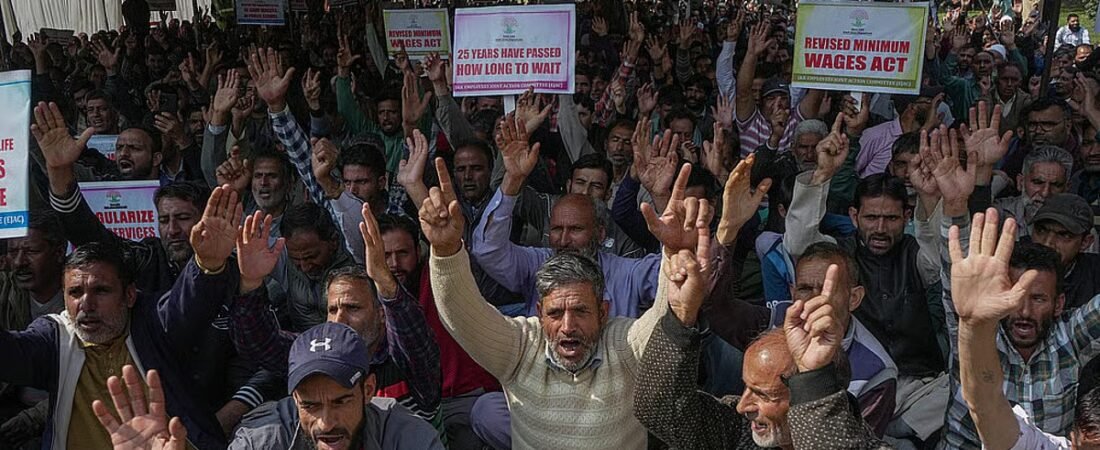
SRINAGAR, September 22, 2026 – More than 1.05 lakh casual and daily-rated workers across Jammu and Kashmir continue to await formal regularisation of their services, highlighting a long-standing employment crisis within the Union Territory’s administrative framework. According to official data, out of the total registered temporary workforce, 57,390 workers are stationed in the Kashmir division, while 40,077 belong to the Jammu region. The highest concentration of these daily-rated employees is engaged in the Public Health Engineering (PHE) and Irrigation & Flood Control (I&FC) sector, which accounts for 38,585 workers. This is followed by significant numbers in other critical departments, including the Power Development Department with 13,616 workers, the Education sector with 12,646, the Forest Department with 8,317, and Public Works (R&B) with 6,801 personnel. For decades, these workers have formed the backbone of essential public utility services, yet they continue to operate without job security, social benefits, or standardized pay scales.
As various employee bodies and political parties intensify their demands for immediate regularisation, the J&K government has officially stated that the complex issue remains under active consideration. Authorities have assured that comprehensive efforts are currently underway to expedite the requisite legal, administrative, and financial examinations, alongside necessary inter-departmental consultations, to formulate a legally sustainable policy. However, expressing deep frustration over the prolonged delays, Sajjad Ahmad Parray, President of the Jammu Kashmir Casual Daily Wagers Forum, announced that thousands of daily wagers will stage a massive protest in Srinagar on Tuesday. The demonstration aims to aggressively press for their formal regularisation, a substantial revision of their current wages, and the restoration of the Old Pension Scheme. Parray raised alarming concerns regarding the demographic reality of the workforce, noting that nearly 30 percent of the total daily-rated employees are scheduled to reach retirement age within the next six to seven months, threatening to leave them without any post-retirement financial security. Highlighting their grim economic conditions, he pointed out that the current monthly salaries of these workers range a meager ₹2,500 to ₹9,000, which is grossly inadequate to sustain their families amidst skyrocketing living costs, especially after years of dedicated service to the government.
Published by True Roots Media Network