
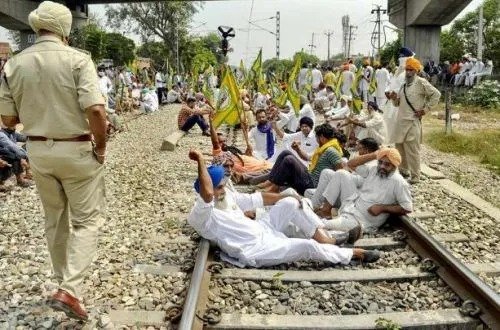
CHANDIGARH, September 18, 2026 – A major ‘rail roko’ agitation by farmers severely disrupted railway operations across Punjab on Thursday, affecting the movement of at least 20 trains, including the crucial New Delhi-Amritsar Shatabdi Express. The six-hour blockade, spearheaded by the Kisan Mazdoor Morcha (KMM), saw farmers squatting on railway tracks at five key locations across the state from 12 noon until 6 PM. The coordinated protests were staged at Devidaspura in Amritsar, the Jhakholhari railway crossing in Pathankot, Dagru in Moga, Mallanwala in Ferozepur, and Sunam in Sangrur. The intense agitation was called off by Thursday evening only after the protesters received a firm administrative assurance that a high-level meeting between their leaders and Punjab Agriculture Minister Gurmeet Singh Khuddian would be held on September 24 to discuss their pressing demands.
The massive disruption caused significant inconvenience to thousands of commuters travelling for work, business, medical treatment, and other essential purposes, forcing many to alter their journeys or seek alternative road transport at the last minute. According to railway officials in the Ferozepur division, the blockade forced the complete cancellation of four trains, including the Beas-Tarn Taran DMU and Ferozepur Cantonment-Jalandhar City services. Furthermore, seven major routes were diverted, including the Amritsar-New Jalpaiguri Amrit Bharat Express, the Amritsar-Ajmer Express, and the Jammu Tawi-Bhagat Ki Kothi Express. The cascading effect of the protests also saw three trains short-terminated, four short-originated, and two services significantly rescheduled.
The suspension of the blockade was finalized following extensive negotiations between farm leaders—including Sarwan Singh Pandher—and senior administrative and police officials, including Inspector General of Police (Border Range) Gurpreet Singh Bhullar and Amritsar Deputy Commissioner Dalwinder Singh. During the talks, the administration assured the farmers that financial compensation and pending jobs for the families of farmers and labourers who died during previous agitations would be provided within a month, alongside commitments to address cases related to stubble burning. The protesting farmers have reiterated their core charter of demands, which prominently includes a legal guarantee for a Minimum Support Price (MSP) on five crops, a comprehensive loan waiver for farmers and farm labourers, and the immediate withdrawal of the state’s land-pooling policy.
Published by True Roots Media Network