
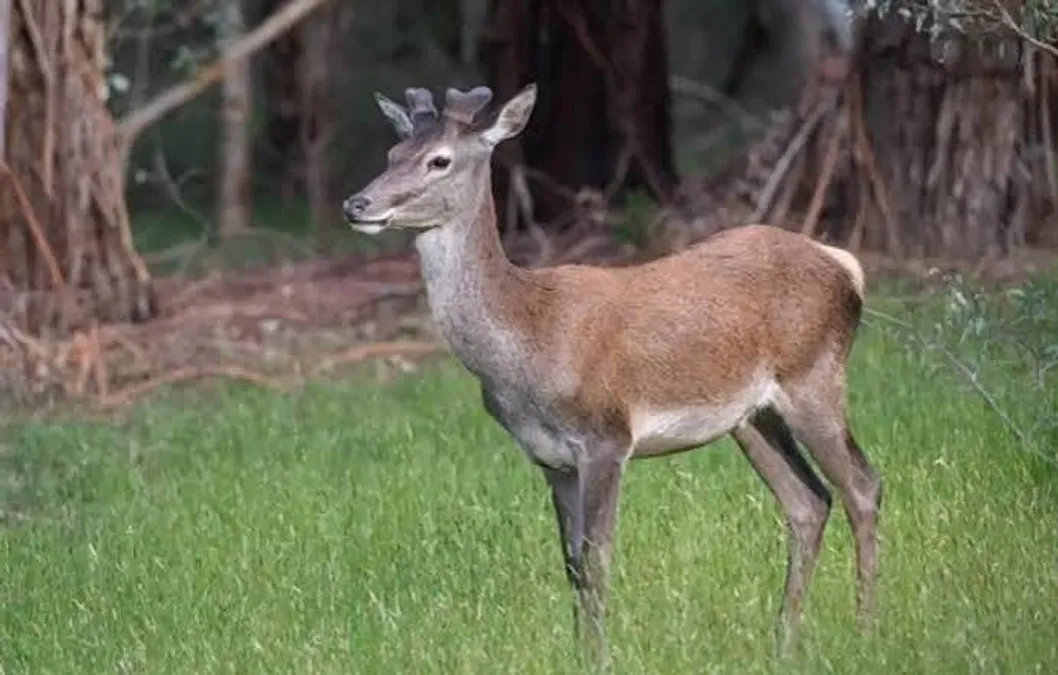
Srinagar, Nov 10: The confirmed visual recording of a female Sambar deer near Sinthan Top in south Kashmir’s Anantnag district has sparked keen scientific interest among wildlife conservationists, signaling that the vulnerable ungulate species may be expanding its home range across the Pir Panjal divide into the Kashmir Valley.
The animal was spotted by travellers traversing the mountain pass near Daksum on the Kashmir approach to Sinthan Top, according to regional wildlife department officials. This significant encounter follows earlier documented observations in the area, including the recording of a male Sambar near Achabal in April 2024 and another adult near Sinthan Top late last year. The species has historically maintained its regional strongholds predominantly within the Jammu division, spanning the Kishtwar, Bhaderwah, Doda, and Udhampur forest tracts.
Wildlife researcher and Wildlife Warden for North Kashmir, Intesar Suhail, noted that documented sightings of both a male and a female specimen at disparate times suggest the movements represent broader territorial adaptation rather than an isolated wandering incident. Suhail emphasized that wildlife authorities will initiate scientific monitoring and systematic camera-trapping exercises across the upper reaches to determine whether resident herds have formed and evaluate potential breeding patterns.
Wildlife Warden for the Anantnag-Kulgam range Sajad Bhat explained that the contiguous forest canopy connecting the high-altitude Sinthan pass to the dense woodlands of Kishtwar creates a natural migratory corridor. Forest shifts could be driven by changing climatic patterns, seasonal forage searches, or population pressures in contiguous ranges.
Classified as Vulnerable on the International Union for Conservation of Nature (IUCN) Red List since 2008 due to historical poaching and forest fragmentation, the Sambar (Rusa unicolor) is the largest deer species native to the Indian subcontinent. Its prospective establishment in Kashmir adds a promising ecological dimension alongside the Valley’s indigenous fauna, including the endangered Hangul, musk deer, and markhor.
Published by True Roots Media