
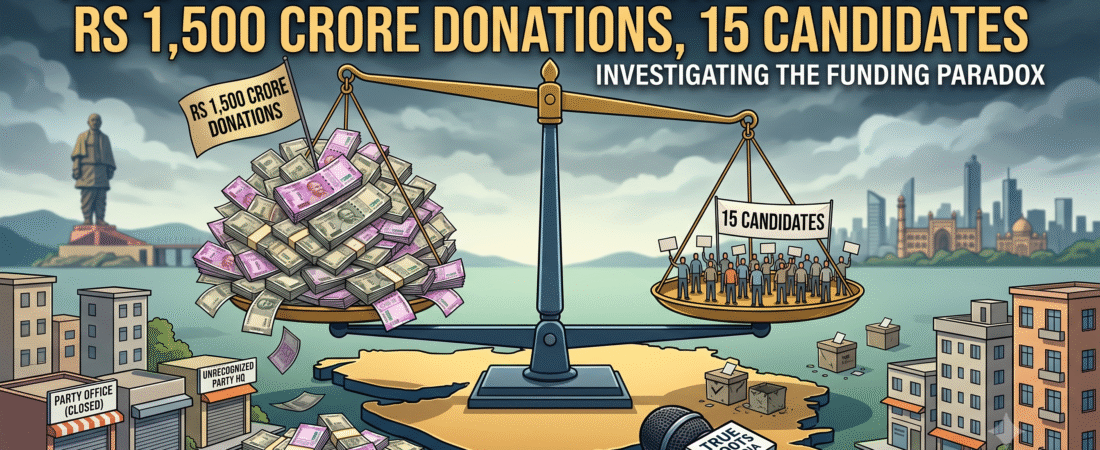
NEW DELHI, September 5, 2026 – In a startling revelation that highlights potential loopholes in political funding, six registered but unrecognized political parties headquartered in Gujarat received more than ₹1,500 crore in donations during the 2022-23 financial year. This massive sum astonishingly exceeded the combined donations received by all national parties during the same period, with the exception of the BJP.
According to an investigation by BBC Hindi, the six parties—Satyavadi Rakshak Party, Aam Janmat Party, Gareeb Kalyan Party, Swatantrata Avivyakti Party, Bharatiya National Janata Dal, and New India United Party—operate out of Gujarat, with five based in Ahmedabad and one in Anand. Despite their massive financial influx, these parties collectively fielded just 15 candidates in the 2024 Lok Sabha elections.
1.Astronomical Donations vs. Electoral Footprint:
The investigation revealed that individual donations to these obscure parties ranged from ₹138 crore to an astronomical ₹620 crore. The Aam Janmat Party was the largest recipient with ₹620 crore, while the Gareeb Kalyan Party received the lowest among the six at ₹138 crore. Despite these deep pockets, physical checks of their registered addresses revealed little to no substantial activity, with offices traced to residential flats and shut shops in commercial complexes. For instance, the Satyavadi Rakshak Party, which received ₹330 crore, fielded just one candidate and claimed to have spent ₹316 crore on undocumented charity.
2.The Suspected Tax-Relief Mechanism:
While the law legally permits registered political parties to receive donations—rendering the contributions eligible for tax exemptions for both the donors and the parties—financial experts have raised red flags. Chartered accountants suggested a potential mechanism where donors obtain donation certificates to claim income-tax relief, and subsequently receive a large portion of the money back from the political parties after deductions categorized as “service charges”. Consequently, the Income Tax department has already scrutinized some of these contributions, recovering part of the money as tax from certain donors.
3.Exploiting the Electoral Loophole:
The Election Commission of India (ECI) requires all registered parties to have their accounts audited and file annual returns. Recently, the ECI deregistered over 800 unrecognized political parties for failing to contest elections or field a single candidate. However, by collectively fielding exactly 15 candidates in the 2024 Lok Sabha polls, these six Gujarat-based parties successfully maintained just enough of an electoral presence to avoid deregistration, preserving their status and ability to receive tax-exempt funding.
The findings cast a renewed spotlight on the urgent need for stringent financial auditing and regulatory oversight of Registered Unrecognized Political Parties (RUPPs) to prevent the potential misuse of political funding laws for large-scale tax evasion.
Published by True Roots Media Network