
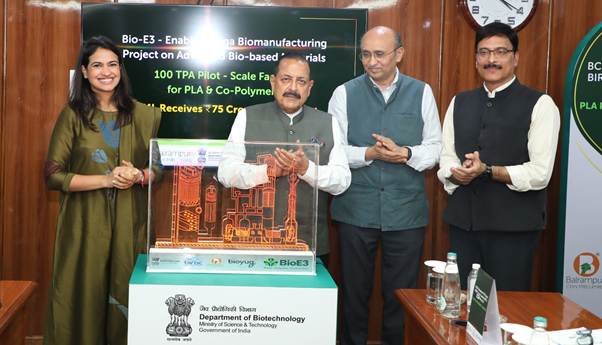
NEW DELHI, September 25, 2026 – In a significant leap towards next-generation sustainable manufacturing, Union Minister of State for Science & Technology, Dr. Jitendra Singh, formally launched the commercial use of bio-based biodegradable plastic derived from Polylactic Acid (PLA) in New Delhi on Thursday. The pioneering initiative, driven by Balrampur Chini Mills Limited (BCML) under the central government’s BioE3 (Biotechnology for Economy, Environment & Employment) framework, seamlessly combines biotechnology, sustainable industrial manufacturing, and commercial translation. Bolstering this green transition, a ₹75 crore grant from the Biotechnology Industry Research Assistance Council (BIRAC), under the Department of Biotechnology, is actively supporting the establishment of a 100-TPA pilot-scale R&D facility. This advanced facility will be set up at BCML’s integrated manufacturing complex situated in Kumbhi, Uttar Pradesh, and is aimed at developing and scaling up PLA and co-polymer technologies for sustainable material applications.
Speaking on the occasion, Dr. Jitendra Singh heralded the initiative as a monumental milestone in India’s bioeconomy journey, demonstrating how advanced biotechnology is finally moving beyond laboratory research and translating directly into commercial products and employment generation. Highlighting the sector’s exponential growth, the Minister stated that India’s bioeconomy has expanded rapidly from around US$10 billion in 2014 to an impressive US$195 billion today. He emphasized that the PLA initiative will substantially strengthen India’s ability to participate in the global transition towards sustainable manufacturing by creating an entirely new value chain based on biological resources. The project powerfully showcases how indigenous scientific capabilities can be effectively linked with industrial-scale production to create high-value materials while simultaneously addressing critical global environmental concerns.
A central theme of the Minister’s address was the innovative “waste to wealth” approach. Dr. Singh stressed that materials often discarded as waste contain significant underlying value that can be unlocked through science and technology, noting that India’s diverse experience with biomass conversion and recycling gives the country a unique opportunity to develop sustainable solutions with wider global relevance. He further called for the commercial translation of research to occur at an early stage, ensuring technologies move swiftly from laboratories to markets through robust pilot facilities, comprehensive validation, skilled manpower, and active industry participation. The successful commercialisation of PLA-based biodegradable plastic not only curtails dependence on single-use plastics but also solidifies India’s emergence as a global leader in the bioeconomy, capable of providing practical, technology-driven environmental solutions to the rest of the world.
Published by True Roots Media Network