
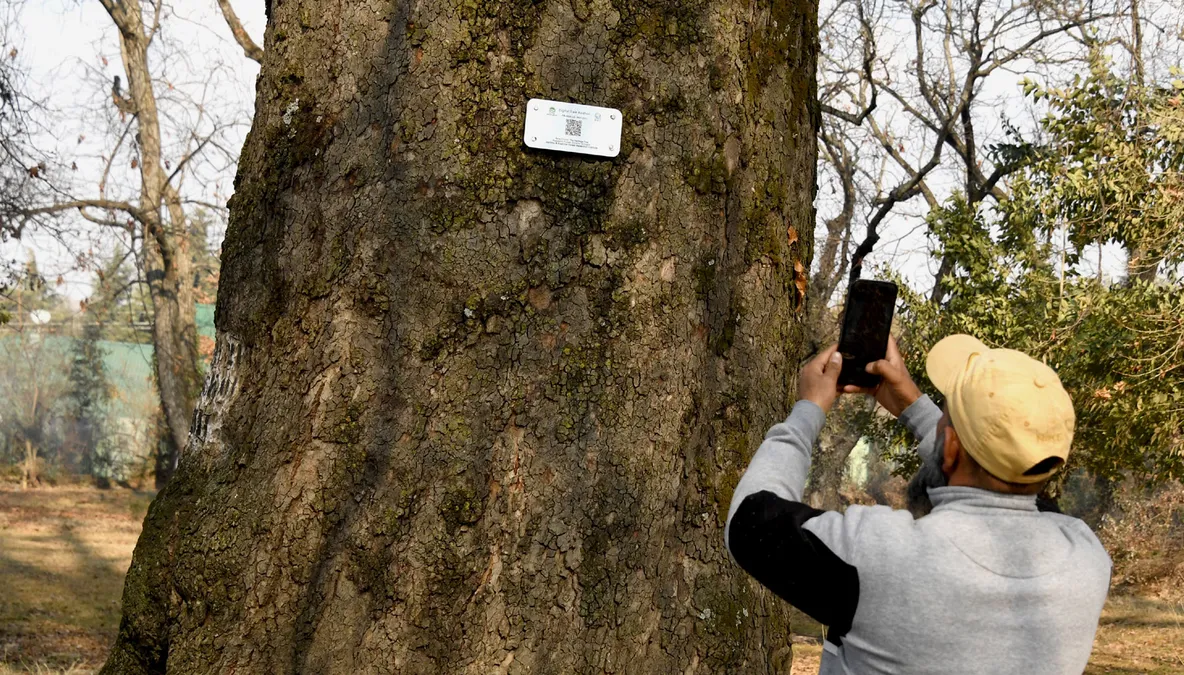
Jammu / Srinagar – November 7: In a landmark environmental conservation initiative aimed at preserving the botanical and cultural heritage of the Union Territory, the Jammu and Kashmir government has completed the geo-tagging of approximately 30,000 iconic Chinar trees (Platanus orientalis), establishing a comprehensive digital surveillance database for their scientific monitoring and protection.
The milestone was reviewed during a high-level review session of the Jammu and Kashmir Forest Research Institute (JKFRI), chaired by Minister for Forests, Ecology and Environment, Altaf Ahmad Wani. Forest officials reported that under Phase-I, durable QR-enabled metal identification plates have been affixed to 10,000 prominent Chinar trees across the Kashmir Valley, along with 3,500 heritage Peepal and Bargad trees situated across the Jammu region. The remaining canopy will be mapped and tagged under the upcoming Phase-II rollout.
Emphasizing the vital bridge between academic science and grassroots environmental stewardship, Minister Altaf Ahmad Wani stressed that forestry research must yield tangible ecological and socioeconomic dividends. “Scientific inquiry forms the backbone of modern ecological conservation. Our research findings cannot remain locked within laboratory files; they must directly enrich forest ecosystems, support agrarian communities, and generate sustainable livelihoods,” he affirmed.
Reviewing institutional breakthroughs, officials apprised the Minister that JKFRI has established two state-of-the-art forestry seed banks in Jammu and Srinagar to preserve certified germplasm harvested from dedicated Seed Production Areas. Concurrently, the institute has standardized commercial cultivation protocols for high-value alpine medicinal plants, including Kuth, Tilpushpi, Mushkwala, Pushkarmul, Angur Shefa, and Shinglimingli, creating nursery stocks to foster agro-forestry entrepreneurship.
Advocating for participatory environmental governance, the Minister directed department heads to actively consult and involve local Members of the Legislative Assembly (MLAs) in executing constituency-level afforestation and soil conservation initiatives, ensuring community oversight, localized wisdom, and transparent project delivery.
Published by True Roots Media