
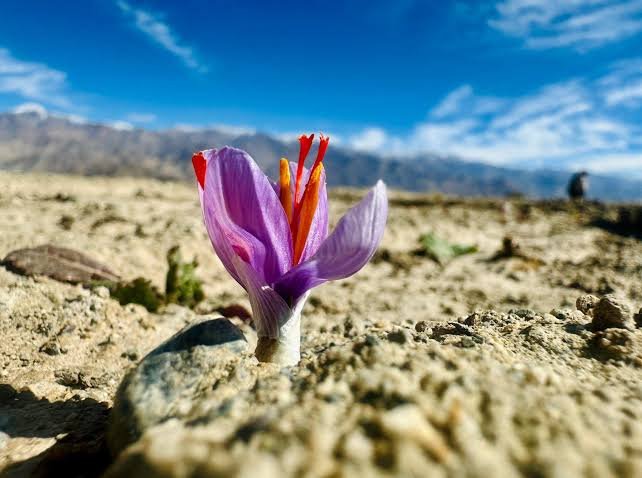
LEH, November 2, 2026 – In a historic milestone for high-altitude farming, Ladakh’s experimental saffron cultivation pilot project has witnessed its first bloom in a record-breaking 30 days, defying the usual two-month timeline. The groundbreaking agricultural achievement promises to open up lucrative new avenues for the region’s farmers.
Initiated just a month ago on October 2, 2026, by Lieutenant Governor Vinai Kumar Saxena, the ambitious pilot project is being undertaken on a piece of recently restored degraded land at Command Area Gate No. 27 in Spituk Pharka, Leh.
For this experiment, approximately 90,000 premium Iranian saffron corms (weighing about 800 kg) were planted over a 4,000-square-meter area. The plantation is linked to a larger land restoration initiative of about 800 acres in Leh, supported by water storage ponds from the Igoo-Phey irrigation canal under ‘Project Him Sarovar’.
Lieutenant Governor Saxena visited the saffron fields on Sunday to witness the early bloom. Sharing the early success on social media, LG Saxena stated, “Breaking new ground in Ladakh’s high-altitude agricultural landscape! Proud to announce that the experimental saffron cultivation, over recently restored degraded land in Leh, has begun to blossom in a record-breaking 30 days against the usual two-month timeline.”
According to the official data, the fields are currently witnessing an average of 20 to 25 flowers blooming daily, with a peak of 72 flowers recorded in a single morning. In just the first four days of flowering, nearly 22 grams of pure saffron have been successfully collected.
Saffron (Crocus sativus), one of the world’s most expensive spices, is traditionally associated with Jammu and Kashmir and Iran. Successfully cultivating it in the cold desert of Ladakh could prove to be a massive economic boon.
Describing the achievement as a testament to environmental resilience and the untapped potential of Ladakh’s climate for high-altitude farming, the LG noted that this initiative will lead to agricultural diversification, generate agro-based entrepreneurship, and significantly boost farmers’ incomes. “It advances the vision of a self-reliant Ladakh,” he stated.
LG Saxena also extended his congratulations to the Ladakh Agriculture Department and the dedicated field staff for their hard work and vital contribution to the successful implementation of the pilot project.
Published by True Roots Media Network