
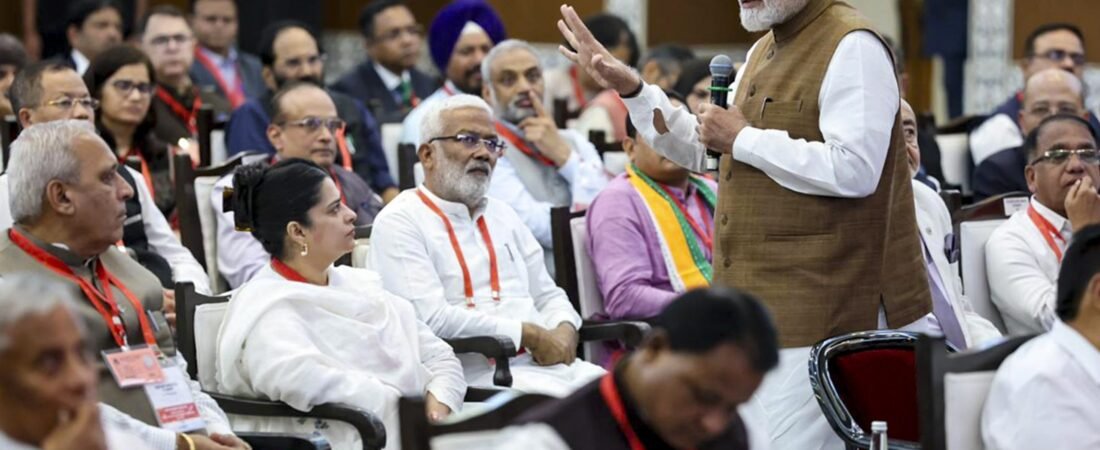
NEW DELHI, September 3, 2026 – Prime Minister Narendra Modi on Wednesday called for a sustained “Team India” approach to tackle the country’s growing water challenges. Chairing the valedictory session of the two-day National Departmental Summit on Water, the Prime Minister emphasized the need for continuous review, technology-driven data management, and greater public participation.
The summit, held on September 1 and 2, marks the first in a series of Departmental Summits envisioned by the Prime Minister. The initiative aims to strengthen cooperative federalism and foster a sense of collective ownership of national priorities among states and the Centre.
1.AI and Data-Driven Governance:
Technology and data figured prominently in the Prime Minister’s agenda. He called for robust water data governance by systematically pooling, managing, and analyzing water-sector data. Modi strongly recommended the integration of Artificial Intelligence (AI) for data collection and analysis through a uniform format to significantly improve the quality and utility of water-related information for policy planning.
2.Community Participation and ‘Jal Utsav’:
Underscoring the critical importance of Jan Bhagidari (public participation), Modi advocated for the wider promotion of “Jal Utsav” initiatives. These festivals aim to build mass awareness regarding water conservation and encourage communities to treat water management as a shared, collective responsibility. He also directed authorities to make de-silting a regular exercise with standard operating procedures.
3.Anticipatory Planning and Urban Challenges:
Addressing the mounting pressure on urban water resources, the Prime Minister highlighted the necessity of sensitizing Urban Local Bodies (ULBs) to the realities of rapid urbanization and population growth. He proposed organizing specialized “Chintan Shivirs” for ULBs to develop practical solutions. Furthermore, he stressed the need for anticipatory and integrated planning—including the utilization of treated water for agriculture and industries—to preemptively address water scarcity before it becomes a crisis.
Drawing upon his tenure as the Chief Minister of Gujarat, Modi noted that with systematic planning, commitment, adequate resources, and capable officials, water scarcity can be successfully converted into an opportunity for growth and resilience. He urged states to learn from successful interventions and adapt them to their own local requirements through structured inter-state study visits.
Published by True Roots Media Network