
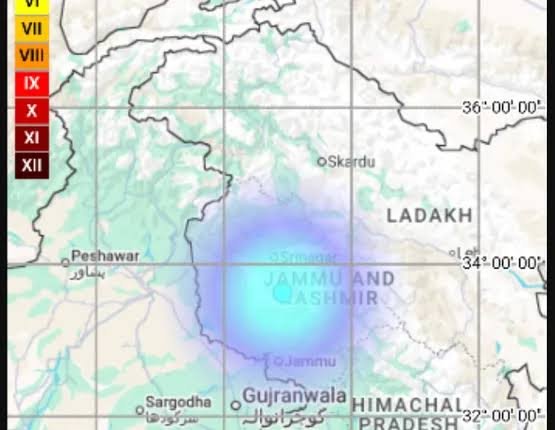
SRINAGAR, November 2, 2026 – A 3.6-magnitude earthquake that struck south Kashmir’s Kulgam district early Friday has brought renewed attention to the severe seismic risks facing the highly vulnerable Kashmir Valley.
According to the National Centre for Seismology, the mild tremor originated at a latitude of 33.628° north and a longitude of 74.922° east, at a shallow depth of 10 kilometers. While the quake caused tremors across Shopian, Kulgam, Anantnag, and Pulwama, there were no immediate reports of structural damage or loss of life. However, experts warn that the event should not be dismissed lightly, as it serves as a critical reminder of the active tectonic strain building beneath the region.
The Kashmir Valley is crisscrossed by multiple active faults, making it one of the most earthquake-prone regions in South Asia. In light of Friday’s tremor, earth scientists and structural experts have urgently called for detailed seismic microzonation and comprehensive active fault mapping to accurately assess localized earthquake risks across the Himalayan region.
“The presence of a common active tectonic system does not imply identical seismic hazard everywhere. Broad regional zoning often oversimplifies local variations,” noted an expert quoted in a recent Greater Kashmir report.
Experts point to two major peer-reviewed scientific studies published earlier in 2026, which issued stark warnings about the Kashmir Valley’s serious earthquake risks. These studies highlighted the dangerous combination of active Himalayan faults, immense tectonic strain, liquefaction-prone soils within the valley, and a vast inventory of structurally vulnerable buildings.
To mitigate the potentially catastrophic impact of future high-magnitude seismic events, experts are heavily advocating for the strict enforcement of earthquake-resistant building codes for all new constructions. They also stressed the urgent need to assess and retrofit vulnerable, aging structures, and called upon the administration to mandate regular safety and evacuation drills in schools, hospitals, and public institutions across the Union Territory.
Published by True Roots Media Network