
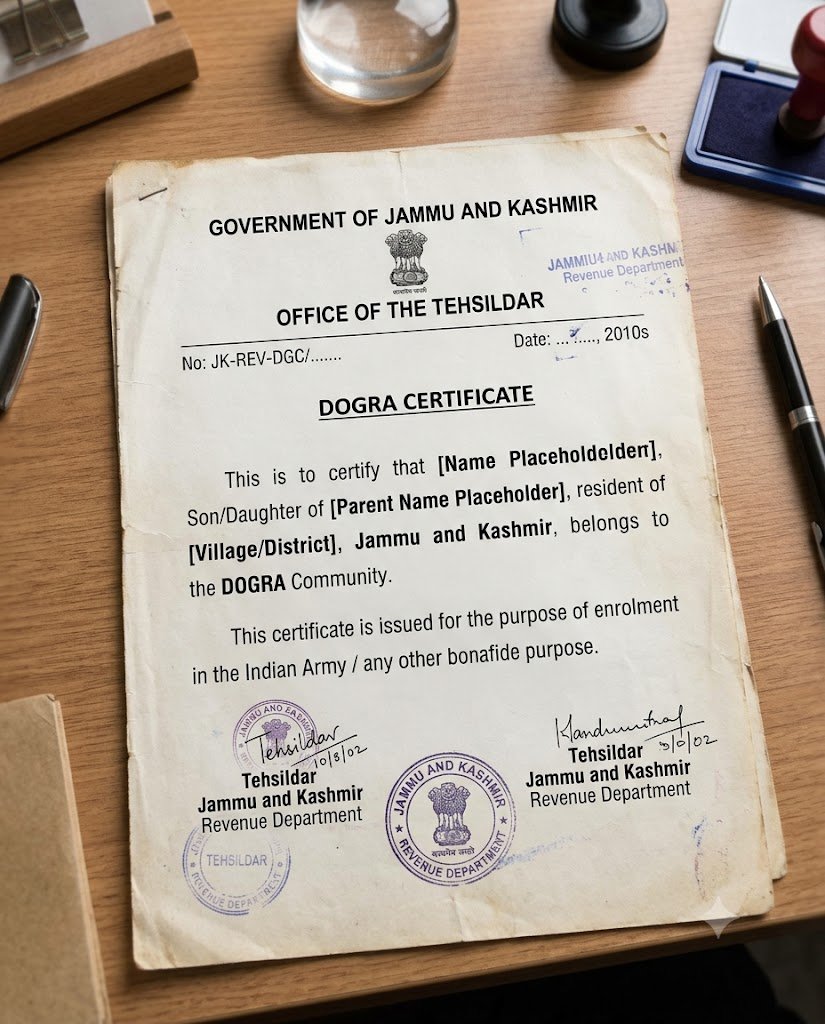
JAMMU, November 2, 2026 – The issue of the ‘Dogra Certificate’ in Jammu and Kashmir (J&K) remains one of the most polarizing administrative subjects in the region’s recent history. The certificate—a document certifying the ethnic identity of the Dogras—has historically served a specific functional purpose, but its issuance became the center of a massive political and regional crisis.
What is the Dogra Certificate?
The term “Dogra” refers to an Indo-Aryan ethno-linguistic group native to the Jammu region, renowned historically for their martial traditions.
The primary purpose of the Dogra Certificate is tied to recruitment and employment. For decades, candidates belonging to specific communities, including the Dogras of Jammu and Himachal Pradesh, have been granted certain relaxations in the physical standards—specifically minimum height and chest measurements—required for recruitment into the Indian Army and various central paramilitary forces.
To avail themselves of these physical relaxations, aspiring youth from the Jammu region require an official government document certifying their Dogra ethnicity. Therefore, for the people of Jammu, the certificate is fundamentally viewed as an essential employment tool and an acknowledgment of their distinct regional identity.
The 2011 Political Crisis
The certificate transformed into a fierce political battleground in 2011. On March 25, 2011, the Revenue Department of the J&K government—then a coalition between the National Conference (NC) and the Congress—issued Government Order No. Rev. (LB) 69 of 2011. This order formally authorized the issuance of the “Dogra Certificate” to the residents of the Jammu division.
The Backlash in Kashmir: The administrative order immediately triggered a severe backlash across the Kashmir Valley. Hardline separatist leader Syed Ali Shah Geelani spearheaded the protests, characterizing the certificate as a “dubious” attempt by the state and central governments to divide J&K along ethnic, regional, and communal lines.
The protests led to a massive, multi-day shutdown in the Valley, paralyzing shops, transport, and educational institutions. Civil society members and political critics in Kashmir feared that the certificate was a precursor to creating a regional “patriot” or “green card” system. Many viewed it as a long-term strategy to dilute the significance of the Permanent Resident Certificate (PRC), which at the time governed state subject laws and land ownership rights in J&K.
The Government’s Reversal: Faced with escalating tensions and the looming threat of prolonged unrest—reminiscent of the violent 2008 Amarnath land row—the state government struggled to manage the fallout. While Revenue Minister Raman Bhalla (Congress) initially defended the move as a necessary measure for local employment, senior NC ministers admitted the abrupt issuance without broader consensus was a mistake.
Under intense pressure and fearing a complete breakdown of law and order, the government, led by Chief Minister Omar Abdullah, officially revoked the controversial order on April 28, 2011.
The Enduring Divide
The swift revocation pacified the Kashmir Valley but left deep resentment in the Jammu region. Local leaders and groups in Jammu felt that their legitimate economic needs and ethnic identity were sacrificed to appease separatist elements in Kashmir.
Even years later, the demand for a mechanism to certify Dogra ethnicity for military recruitment has periodically resurfaced. Since the abrogation of Article 370 in 2019 and the introduction of new Domicile laws, various Jammu-based social and political groups (such as the Yuva Rajput Sabha) have continued to raise the demand for the restoration of the Dogra Certificate, viewing it as a vital safeguard for regional employment and cultural heritage.
Today, the Dogra Certificate remains a potent symbol of J&K’s internal fault lines—championed as a vital employment right in Jammu, yet historically viewed with deep political suspicion in Kashmir.
Published by True Roots Media Network