
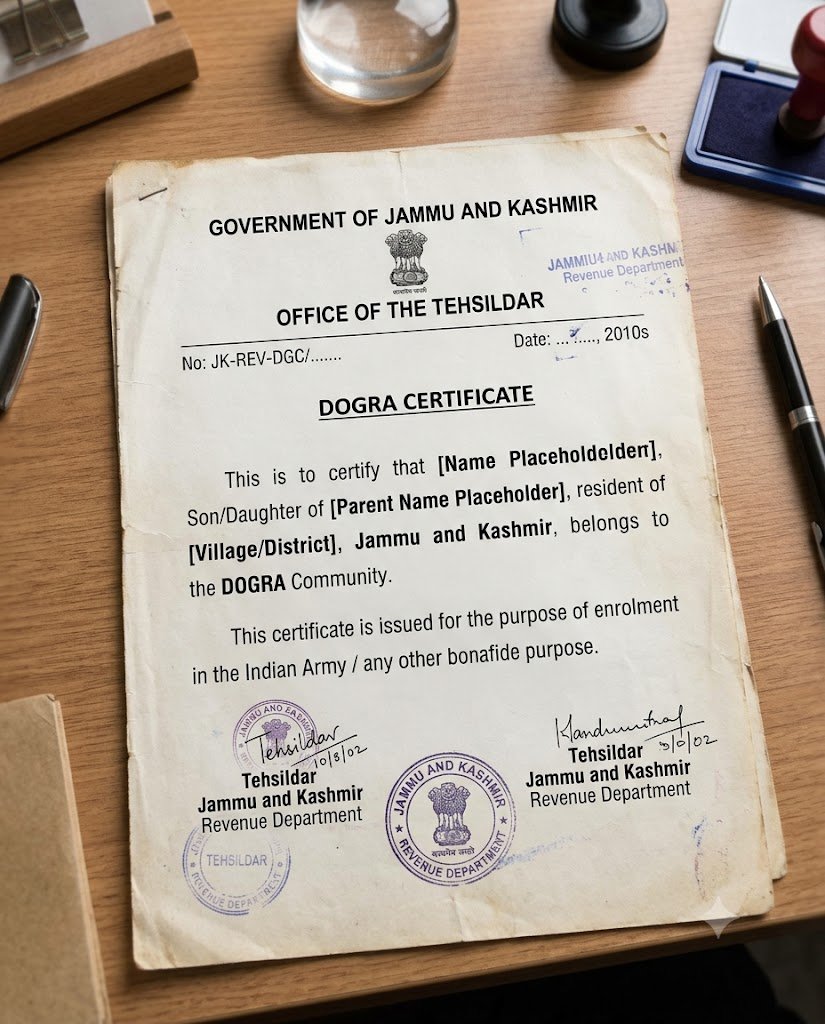
JAMMU, November 2, 2026 – On the bustling Tawi Bridge in Jammu, the slogans raised by protesting youth late last month echoed a grievance that has simmered for over a decade. At the center of their anger is a single administrative document the ‘Dogra Certificate’. While often dismissed in broader political circles as a mere bureaucratic technicality, for the people of the Jammu region, this withheld piece of paper represents a complex intersection of historical legacy, regional rights, and a fight for survival in a rapidly changing demographic landscape.
To understand the Dogra Certificate controversy from the perspective of Jammu is to look past the political rhetoric of the Kashmir Valley. It is a story of a deep-seated regional anxiety, where locals feel their economic rights and a fading historical identity have been repeatedly sacrificed at the altar of political appeasement.
The Roots of the Issue
The Dogras are an Indo-Aryan ethno-linguistic group native to the Jammu region, holding a deeply ingrained martial and cultural tradition. It was the Dogra dynasty, beginning with Maharaja Gulab Singh in 1846, that originally consolidated the vast, diverse territories of the erstwhile princely state of Jammu and Kashmir.
However, local activists and cultural preservationists argue that in the decades since independence, Dogri culture, language, and heritage have been systematically marginalized. Against the backdrop of this perceived cultural erasure, the Dogra Certificate is viewed as a vital safeguard. Local leaders emphasize that the certificate is not merely a piece of paper, but a government-recognized stamp of their ethnic roots an official acknowledgment of a glorious history for a community struggling to keep its unique identity alive.
The Pragmatic Need
Beyond the emotional and cultural weight, the certificate is fundamentally tied to economic survival. Recognizing the historical martial lineage and the specific physical characteristics of the Dogra community, the Indian armed forces and central paramilitary organizations have long offered specific relaxations in physical recruitment standards (specifically, slight reductions in the minimum required height and chest measurements).
These relaxations are not a unique political favor, but a standard military recruitment practice across India for specific ethnic groups with distinct physical traits, such as Gorkhas or Marathas. To seamlessly avail themselves of these relaxations and secure steady government employment, the youth of Jammu require a formalized document certifying their Dogra ethnicity.
The 2011 Flashpoint
The frustration in Jammu reached a boiling point in 2011. To streamline the recruitment process for local youth, the J&K Revenue Department—under the NC-Congress coalition government issued an order on March 25 to formally authorize the issuance of the “Dogra Certificate.”
However, this straightforward administrative step was immediately met with fierce political resistance in the Kashmir Valley. Hardline separatist leader Syed Ali Shah Geelani issued an ultimatum, framing the certificate as a “dubious” demographic conspiracy designed to divide the state and dilute the Permanent Resident Certificate (PRC) laws.
Despite the fact that the Dogra Certificate had no bearing on Kashmir’s demographics or state subject laws, the Valley was plunged into a massive shutdown. In response to the escalating protests, Chief Minister Omar Abdullah’s government convened a cabinet meeting and officially revoked the Dogra Certificate order in April 2011.
A Double Blow to a Region
For Jammu, this swift revocation was perceived as a historic betrayal. It was seen as a double blow: a denial of their legitimate employment rights and a direct insult to their cultural identity. The decision sent a clear message to the region that their economic survival and ethnic recognition were expendable, readily sacrificed to appease separatist sentiments and political anxieties in the Valley.
Today, the scars of that 2011 revocation remain fresh, and the fear of cultural amnesia has only grown. Even after the abrogation of Article 370 in 2019 and the introduction of new Domicile laws, the specific functional and cultural need for the Dogra Certificate has not vanished.
Recent protests in late October 2026, organized by youth groups and organizations like the Rajput Ekta Manch, have fiercely reignited the demand. For the people of the Jammu division, the fight for the Dogra Certificate is far from over. They argue that as long as the certificate is withheld out of fear of political backlash, the Dogra community will continue to be denied both their rightful opportunities to serve the nation and the official recognition of their heritage.
Published by True Roots Media Network